Chattogram port’s empty-container problem needs more than quick fixes
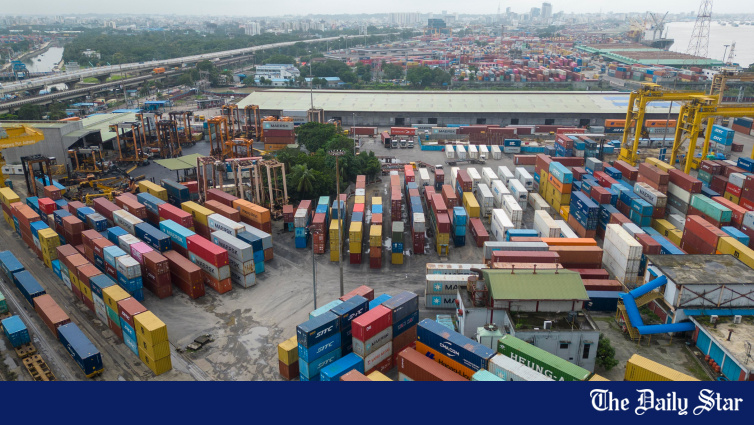
A recent dispute over empty containers at Chattogram port has brought to renewed focus a deeper problem in Bangladesh’s trade logistics system: when legitimate interests collide, there is no neutral, technically competent authority to resolve the situation.
The case, as per a report published on July 9, involved a letter sent by the World Shipping Council asking the Chattogram Port Authority (CPA) to stop requiring vessels, sometimes at short notice, to carry empty containers not included in their loading plans. Shipping lines argue that such last-minute additions can disrupt stowage plans and vessel-stability calculations required under the International Convention for the Safety of Life at Sea (SOLAS), while creating operational and compliance risks. CPA, meanwhile, faces genuine pressure to prevent yard congestion.
Both positions deserve consideration. The CPA must maintain port fluidity, but congestion control should not compromise vessel planning and safety requirements. The problem lies in a system that often resolves pressure by shifting it from one stakeholder to another.
During the severe port congestion in 2007, under the army-backed caretaker government, the joint forces introduced exceptional measures to clear accumulated containers. Having witnessed that period professionally, I recall the compulsory evacuation of empty containers emerging as one such crisis response. Emergency interventions may be understandable during periods of extraordinary congestion, but they should not become permanent operating models.
More than a decade later, in February 2023, The Daily Star reported that CPA had agreed to end the forced shipment of empty containers following objections from shipping agents and container carriers. This raises the question: if the practice was challenged and an assurance given to discontinue it, why has the problem returned? Perhaps the practice was addressed, but the system pressures that produced it were not.
Those pressures become clearer when we examine the full life cycle of a container. After the arrival of an import-laden container, it is delivered to the consignee and eventually becomes empty. Globally, containers are considered as circulating transport assets whose value is determined by efficient reuse and repositioning. In Bangladesh, regulatory constraints can limit that flexibility.
Bangladesh has not acceded to the Customs Convention on Containers, 1972. Under the present customs framework, containers remain subject to strict control because of potential duty implications and re-export requirements. While such safeguards serve legitimate purposes, they can restrict carriers’ flexibility in managing equipment cycles.
Subject to proper customs control, a shipping line should be able to reposition an import container or reuse it for export when operationally suitable. When flexibility is constrained, more empty movements and longer storage cycles may take place, adding pressure to depots and port yards. Bangladesh should examine whether its framework strikes the right balance between customs control and efficient circulation of international transport equipment. Accession to the 1972 convention, supported by national legislation and digital tracking, deserves consideration.
Storage policy acts as another constraint. The private Inland Container Depot (ICD) and off-dock framework require substantial minimum land for establishing facilities. Such requirements may be reasonable for a full-service ICD or CFS (container freight station) handling cargo, customs formalities, stuffing, and unstuffing. But should the same model apply to a specialised vanpool, such as a depot for empty containers?
A facility principally storing empty equipment has a different operational profile. It still needs adequate space, safety standards, handling equipment, and digital inventory control, but regulation should reflect function and risk. If a land threshold designed for a full-service ICD prevents smaller specialised facilities from entering the market, it may restrict the very capacity needed to relieve empty-container pressure.
A similar issue arises with the transfer of FCL (full container load) imports from the port to private off-docks. Only select categories of goods may move to these facilities for customs clearance and delivery, partly because of capacity concerns. Yet, some modern off-docks maintain that they have unused land, equipment, and operational capability.
Neither claim should simply be accepted. Capacity should be measured through yard occupancy, equipment, gate capacity, dwell time, safety, customs readiness, and digital connectivity. Qualified facilities could handle additional cargo under a risk-based framework. The question should evolve from “which items are on the list?” to “which accredited facilities have the capacity and compliance record to handle which cargoes?”
Restrictions on container reuse can lead to the requirement of moving empty containers. Limited external storage reduces the system’s ability to absorb them. Restricted off-dock utilisation keeps more import activity within the port. CPA then faces yard pressure and seeks rapid evacuation. Shipping lines are pressed to carry the empty containers and a dispute arises.
At each stage, a different institution sees only a part of the problem. CPA sees yard congestion. Customs and the National Board of Revenue see revenue protection and regulatory control. ICD regulators look into licensing and infrastructure. Shipping lines see vessel safety, equipment utilisation, and international compliance. Off-dock operators see unused capacity. Exporters and importers see delay and cost.
Each may act rationally within its mandate, yet the combined outcome can still be inefficient. No single institution examines how these mandates interact. This is where the core governance gap lies.
Bangladesh does not lack institutions in logistics; it lacks a neutral institution capable of governing the space between them. The National Logistics Policy 2025 offers an opportunity to address this through an independent National Logistics Commission, which would not run ports, direct Customs on individual consignments or interfere with the shipmaster’s responsibility for vessel safety. Instead, it could review cross-sector bottlenecks and market-entry barriers, promote performance and digital interoperability, and provide a specialised forum for mediation and dispute resolution.
The empty-container controversy could then be examined as a system problem rather than a confrontation between CPA and shipping lines. Why are empty containers accumulating? Do customs rules permit efficient equipment circulation? Are depot requirements proportionate? Which off-docks have spare capacity? What protocol should govern empty repositioning during normal operations and genuine congestion emergencies?
Today, no institution is responsible for answering these questions together. As Bangladesh modernises its ports and attracts global operators, relationships among authorities, operators, carriers and cargo owners will become more complex. Disputes will not disappear; they will become more sophisticated. The answer is not to eliminate disagreement, but to create a credible place where it can be resolved.
The empty-container dispute is therefore more than a disagreement over a port practice. It reminds us of the need for a neutral referee when operational problems become recurring disputes.
Ahamedul Karim Chowdhury is adjunct faculty member at Bangladesh Maritime University.
Views expressed in this article are the author's own.
Follow The Daily Star Opinion on Facebook for the latest opinions, commentaries, and analyses by experts and professionals. To contribute your article or letter to The Daily Star Opinion, see our guidelines for submission.