Salinity creeps deeper into southwest
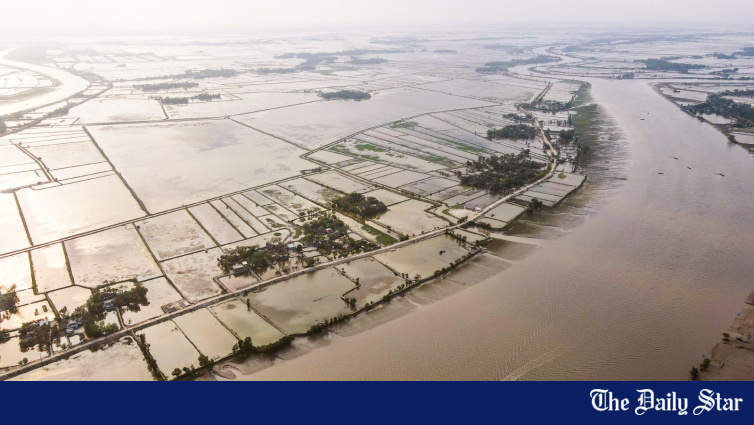
Saltwater is rapidly intruding into Bangladesh's southwestern region, with nearly 68 percent of cultivable land affected in 18 of 19 coastal districts, according to a new government study.
Experts warn that the spread is contaminating both soil and groundwater, increasingly threatening food production and the livelihoods of millions.
At least 11.56 lakh hectares of the region's 17.03 lakh hectares of cultivable land were degraded till 2024, compared to 10.56 lakh hectares in 2009, shows the Soil Salinity Map of Bangladesh 2024, prepared by the Soil Resources Development Institute (SRDI).
This means one lakh hectares or 1,000 square kilometres -- roughly the size of Munshiganj district -- turned saline in only 15 years.
The saline-affected area was 8.33 lakh hectares in 1973, according to the first nationwide assessment done after the country's independence.
"It is worrying that both the area and intensity of salinity intrusion in the coastal zone are increasing day by day," Ameer Md Zahid, chief scientific officer (CSO) and divisional head at SRDI, Dhaka, told The Daily Star.
Salinity has emerged as one of the gravest environmental threats to the coastal districts, which account for nearly one-third of the country’s land area and are home to about 4.38 crore people.
The inhabitants of the region, especially Khulna, Satkhira and Bagerhat, are already grappling with declining crop yields, dwindling freshwater supplies, and worsening living conditions.
The latest findings show how salinity is putting additional pressure on an agriculture sector already shrinking because of urbanisation.
Worryingly, three upazilas -- Kashiani and Muksudpur in Gopalganj, and Jashore Sadar -- have appeared on the salinity map for the first time, signalling that the problem is spreading into fertile inland areas.
The study, conducted for two years from 2022, warns that Alfadanga in Faridpur and Mohammadpur in Magura could be the next areas to face salinity intrusion as future sea-level rise may push salinity further inwards.
"If urgent measures are not taken now, more areas will become saline, posing a serious threat to agricultural production and food security," said Zahid, who led the assessment team.
Salinity in the coastal zone is partly driven by natural forces such as storm surges, but human interventions over several decades have dramatically hastened the process, Zahid said.
The Coastal Embankment Project, launched in the 1960s to protect low-lying areas from tidal floods, relied on embankments and polders that blocked natural tidal flows, disrupting the delta's drainage system and causing saline water to stagnate inside polders during high tides.
Many of the sluice gates built to manage that water are either damaged or poorly maintained.
Upstream diversion of freshwater, particularly through the Farakka Barrage since 1975, has reduced dry-season flows into Bangladesh's southwestern rivers, weakening the natural flushing mechanism.
The study said the southwest region has suffered some of the sharpest deterioration, driven by declining freshwater flows through rivers like Garai-Madhumati and Kopotakkho.
However, the south-central zone -- covering most of Barishal Division and part of Chittagong Division -- has remained less affected, thanks to steady flows from the Padma and Lower Meghna rivers.
Unchecked shrimp farming has compounded the damage. Over the last four decades, paddy fields across the southwestern region were converted into shrimp enclosures -- locally called ghers -- that require saltwater.
The deliberate cutting of embankments to fill these enclosures allowed saline water to travel farther inland.
Climate change, sea-level rise, erratic rainfall, cyclones, and storm surges are amplifying the threat, pushing saline water deeper inland.
The SRDI study maps a grim trajectory of salinity.
The size of saline-affected land expanded by 22.47 percent between 1973 and 2000. Though the expansion slowed to a modest 3.5 percent between 2000 and 2009, it surged by 9.43 percent from 2009 to 2024.
Over five decades, 3.23 lakh hectares of non-saline cultivable land have been lost to salinity.
SRDI classifies the affected land into five mapping units -- from very slightly saline to very strongly saline -- with crop yields declining markedly as salinity levels rise.
At present, 1,15,600 hectares or 10 percent of all affected land in Bangladesh fall under the "very strongly saline" category, up from 1,01,920 hectares in 2009.
Salinity exposure varies sharply: while about 35 percent of cultivated land is saline in the least-affected zones across the coastal districts, the figure is 99 percent in the worst-hit zones.
"It is evident that non-saline and very slightly saline cultivated land is increasingly shrinking in the coastal region," the study said.
Agricultural economist Prof MA Sattar Mandal said Bangladesh's arable land has shrunk from around 90 lakh hectares two decades ago to nearly 80 lakh hectares at present.
Farmland has become increasingly fragmented as the number of farm holdings has grown, while rising soil and water salinity has further reduced agricultural productivity, said Prof Sattar, also a former vice chancellor of Bangladesh Agricultural University.
Md Sazzadur Rahman, chief scientific officer at Bangladesh Rice Research Institute (BRRI), said dry-season cultivation has become extremely difficult in the worst-hit parts of Satkhira, leaving farmers reluctant to take risks.
Salinity is also affecting livestock farming in the region, as a fall in rice cultivation has reduced the availability of fodder.
The effects extend beyond rice and livestock.
Shimul Mondal, senior scientific officer at Bangladesh Agricultural Research Institute (BARI), said pulse and mustard germination is being hampered during the February-May growing season. The cultivation of other crops such as mung bean, once widespread in the region, is also shrinking.
Other studies suggest that the salinity intrusion is unlikely to stop. As sea levels continue to rise around Bangladesh's coast, saltwater is expected to penetrate even further inland over the coming decades.
A 2024 Department of Environment study said that if this trend continues, food production and livelihoods will be hit harder than previously projected.
A separate 2024 report by the International Centre for Climate Change and Development projects that rising seas could submerge 12 to 18 percent of the coastal region by the end of the century, and warns that up to nine lakh people in southern Bangladesh could be displaced by 2050.
In its study, the SRDI recommended adopting improved crop and soil management practices, expanding salt-tolerant crop varieties, introducing submergence-tolerant high-yield strains for aus and aman seasons, and promoting planned agro-fisheries in vulnerable zones.
BRRI and BARI officials said they were already implementing some of the measures mentioned in the study.
BRRI has been helping expand Boro rice cultivation in less-affected areas, while BARI is promoting alternative salt-tolerant crops, including quinoa, sweet potatoes, sorghum, and barley.
However, experts caution that technical fixes alone won't be enough.
"Researchers have developed a number of stress-tolerant varieties of rice and other crops, but farmers don’t adopt these overnight," said Prof Sattar.
"A change in mindset is necessary. Instead of focusing only on investment in research, we should translate our research achievements into action. We need to think seriously about the transformation of our agriculture sector along with commercialisation goals. Our efforts to support new agricultural practices must be concerted."
Sharing a similar view, Sazzadur, CSO of BRRI, said, "A holistic approach is needed to protect agriculture in the face of rising salinity. The Department of Agricultural Extension can take the lead.”
Shimul stressed the need for land zoning to prevent shrimp farming from expanding beyond designated areas, while Zahid suggested immediate repair of sluice gates and polders so that saline water does not stagnate inland.
At the policy level, the SRDI study calls for re-excavating dying river channels to conserve rainwater; tighter limits on groundwater extraction to slow salinity intrusion; and stronger monitoring and forecasting systems.
It also underscores the need for effective international and bilateral dialogue with India to secure greater upstream freshwater flows into Bangladesh's rivers.
With salinity creeping further inland every year, the window for action may not remain open for long.
"We need to move quickly with interventions," Zahid said.