Mid-range apartments prop up ailing property market
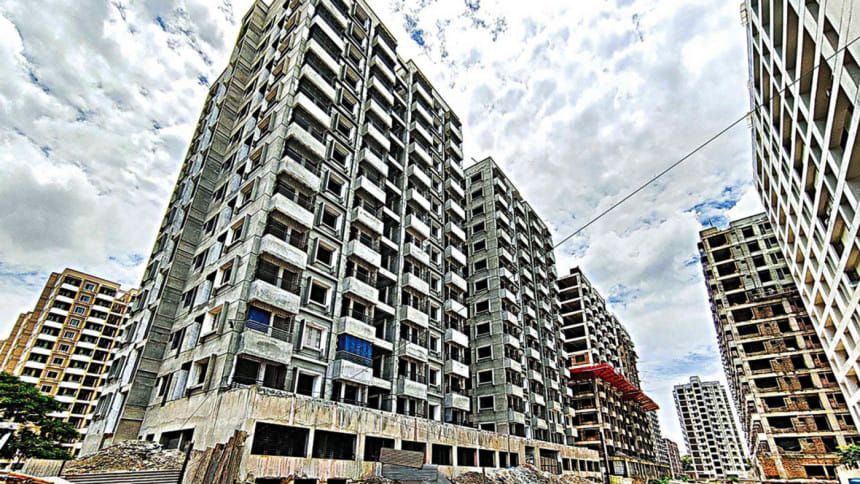
Sales of mid-segment apartments now appear to be the saviour of a property market that has been struggling for nearly three years amid economic turbulence and political uncertaintyRealtors say they once sold around 1,000 units a year, but annual sales have fallen by half after gradual fall over the years.Even so, upper-middle-income families and professionals continue to buy flats priced between Tk 1 crore and Tk 2 crore. These homes, mostly in Dhaka and Chattogram, are roughly 1,200 squar...
Sales of mid-segment apartments now appear to be the saviour of a property market that has been struggling for nearly three years amid economic turbulence and political uncertainty
Realtors say they once sold around 1,000 units a year, but annual sales have fallen by half after gradual fall over the years.
Even so, upper-middle-income families and professionals continue to buy flats priced between Tk 1 crore and Tk 2 crore. These homes, mostly in Dhaka and Chattogram, are roughly 1,200 square feet in size.
"The upper-middle-income group still shows some interest," said Aysha Siddiqua, executive director for brand and communication at real estate developer bti.
Commercial banks also report a stable flow of home loan applications thanks to buyers in this segment.
Meanwhile, demand in the premium market has fallen sharply, according to Shihab Ahmed, chief sales officer at Shanta Holdings.
He said sales in that category, mostly driven by political figures and businesspeople, have dropped by more than 60 percent.
Premium flats are generally over 2,000 square feet and cost more than Tk 2.5 crore.
Developers say wealthy buyers are either in hiding or keeping a low profile following the mass uprising that removed the Awami League government in August last year.
They also noted that the interim government's move to remove the option to legalise undeclared income by investing in property has further deteriorated investment. That provision had previously encouraged part of the wealthy class to purchase large homes.
"People are hesitant to spend under the current economic climate," according to Siddiqua. "Uncertainty is directly affecting apartment sales."
At the lower end of the market – flats measuring 850 to 1,050 square feet and costing less than Tk 1 crore – demand has weakened due to persisting high inflation and bank interest rates.
Apartment sales boomed in fiscal year 2022-23 (FY23) after the Covid pandemic, when pent-up demand pushed the market to a peak. The momentum faded the following year as the wider economy began to show signs of distress.
EVEN THE MID-RANGE DIGESTS A HIT
The mid-range segment may now be propping up the sector, but it has not escaped the property slowdown.
Sales have fallen by 40 percent to 50 percent compared with the FY23, said Ahmed of Shanta Holdings.
He described this category as the main source of cash flow for developers and the lifeline of the entire industry. "When this segment suffers, the entire sector faces trouble."
Meanwhile, bti's Siddiqua said demand for homes has not vanished, but has shifted and become concentrated among mid-range buyers. Low-end customers remain somewhat absent from the market.
She said buyers in the mid segment expect competitive prices, but developers find it difficult to meet that expectation due to the high cost of land and construction materials.
Siddiqua added that discounts are rarely offered publicly. "In real estate, any negotiation on price typically happens one-on-one with the customer."
Despite the fall in sales, especially in the low and high brackets, banks say demand for home loans has stayed stable.
The head of mortgage at a leading private bank said mid-range buyers remain active and group housing initiatives are becoming more common, with professionals joining together to buy land and build homes.
Current home loan interest rates range from 11 percent to 12 percent. The maximum tenure is 25 years, with a ceiling of Tk 2 crore, the official said.
NEW PROJECTS DECLINE
Liakat Ali Bhuiyan, senior vice-president of the Real Estate and Housing Association of Bangladesh (REHAB), said the industry agrees that sales have fallen sharply.
"The market is likely to remain stagnant until uncertainty over national-level decisions is resolved," he said.
The new Detailed Area Plan (DAP 2022-2035) has also affected the sector, as the Rajdhani Unnayan Kartripakkha (Rajuk) has reduced building height and floor area ratios in many locations.
Bhuiyan said this has slowed new projects and stalled some ongoing developments.
Ahmed of Shanta Holdings said declining sales have put many small and mid-sized developers under financial pressure.
He added that high lending rates and liquidity shortages in banks are making it difficult for companies to raise capital.
According to Anup Kumar Sarker, senior executive director of Concord Group, diversified companies are coping better, while those focused on narrow segments face greater challenges.
Sarker said no one can predict when the sector will recover. Once demand returns, however, prices may rise.
REHAB' Bhuiyan said fewer new projects mean supply is shrinking. "Every year there is a natural demand in the market, but when the supply drops below that threshold, pressure builds up, eventually impacting prices."